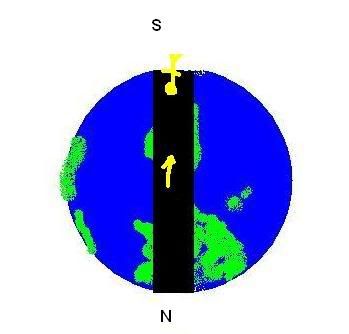
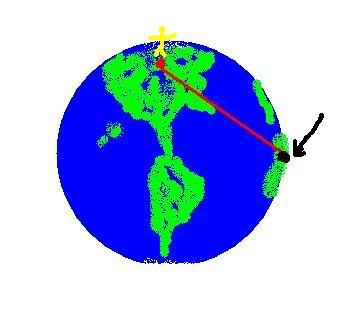
Jeremy wrote:Interestingly as I understand it - if your tunnel goes directly through the Earth, (say from Australia to Germany - a rough guess of directly opposite each other) or if it goes through a lesser amount of the Earth (on an angle) - say Australia to the West Coast of the US - the time it would take for a theoretical object to fall through the tunnel is the same (assuming the fall through the angled tunnel is frictionless - ie. isn't slowed down by hitting the sides).
I don't completely get what you're saying, but I am intrigued.
(just for clarity, we are assuming the earth is a perfect sphere of uniform density and that no outside forces are acting upon it)
The reason why I'm confused is because of the use of the word 'falling'. In the case of the angled tunnel, it would be more like gliding or rolling along the ground... but since we are assuming that there is no friction I guess it's all the same.
One cool thing is that if we ignore those outside forces (such as friction and air drag), then the falling object/person would continue to oscillate back and forth along its path forever, since its total kinetic plus potential energy must always be constant.
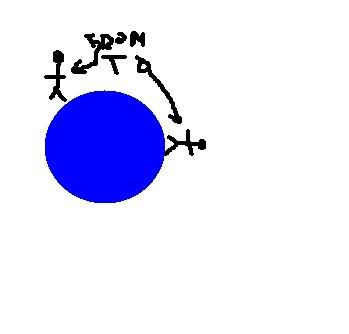
So if I understand you correctly, you're saying that this period of oscillation is the same duration of time, whether you go through the center of the earth or some other path? Since you are starting at the same point (the surface of the planet), then the potential energy is the same, regardless of which path you take. So yeah, I agree with you on the falling times... I think there's some law with pendulums which explains this.

 ?
?