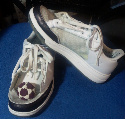
I thought it would be a neat idea. Mabey do a few of your favorite teams colors.

I have no idea how this will affect a footbag that was made with the same pattern. Anyone knowledgable in the area of fluid dynamicshttp://www.eurekalert.org/pub_releases/2006-06/uob-nwc060906.php wrote: New World Cup soccer ball will unsettle goalkeepers, predicts scientist
Scientist backs claims of top goalkeepers
The new soccer ball that will be used for the first time in the World Cup's opening game on Friday (9 June) is likely to bamboozle goalkeepers at some stage of the tournament, a leading scientist has warned.
The Adidas 'Teamgeist' soccer ball has just 14 panels - with fewer seams - making its surface 'smoother' than conventional soccer balls which have a 26 or 32 panel hexagon-based pattern.
This makes it aerodynamically closer to a baseball and, when hit with a slow spin, will make the ball less stable, giving it a more unpredictable trajectory in flight.
"With a very low spin rate, which occasionally happens in soccer, the panel pattern can have a big influence on the trajectory of the ball and make it more unpredictable for a goalkeeper," said Dr Ken Bray, a sports scientist at the University of Bath and author of the new popular science book How to score – science and the beautiful game.
"Because the Teamgeist ball has just 14 panels it is aerodynamically more similar to the baseball which only has two panels.
"In baseball, pitchers often throw a 'curve ball' which is similar to a swerving free kick and the rotating seam disrupts the air flow around the ball in much the same way as a soccer ball does.
"Occasionally though, pitchers will throw a 'knuckleball' which bobs about randomly in flight and is very disconcerting for batters.
"It happens because pitchers throw the ball with very little spin and as the ball rotates lazily in the air, the seam disrupts the air flow around the ball at certain points on the surface, causing an unpredictable deflection.
"With the world's best players in Germany this summer, there are bound to be plenty of spectacular scoring free kicks.
"But watch the slow motion replays to spot the rare occasions where the ball produces little or no rotation and where goalkeepers will frantically attempt to keep up with the ball's chaotic flight path."
The ball, which has been used by teams competing in the World Cup in practice sessions, has already been criticised by England goalkeeper Paul Robinson and Germany goalkeeper Jens Lehmann for its light-weight and unpredictable behaviour.
 ?
?
sooooo.... how fast does a footbag travel when we kick it? If it is less then 12 mph (at least that is the speed that state for a football) then it seems the design will have little affect on its flight path. If its more then who knows.GRAPHIC 1
-Ball travelling under 12 mph suffers considerable turbulence
GRAPHIC 2
-Turbulence moving backwards creates a thin layer of air flow next to the ball
-With air flow clinging more closely, turbulence is reduced and drag plummets
-This is called "tripping" the boundary layer
Above a certain speed - about 12 mph for a football - a miraculous thing happens. Turbulence begins to move backwards, producing a boundary layer - a layer of very thin flow very close to the ball's surface - and this has the effect of causing the air flow to cling more closely to the ball's surface - graphic 2.
GRAPHIC 3
-Spinning ball distorts air flow around ball
Spinning ball distorts air flow around ball
Turbulence is reduced and the drag plummets. When this happens we say that the boundary layer is "tripped" and since most of footballs' actions such as kicking or throwing take place above the critical speed the ball can be moved around in a pacey manner.
When the ball rotates - see graphic 3 - the boundary layer remains tripped but the air flow separation around the ball is distorted. Separation occurs earlier on the side rotating against the flow and later on the side rotating in the same sense as the flow. This causes a pressure differential and a deflecting force which is responsible for moving the ball in the air in a free kick.
It was not realised for many years that the boundary layer was tripped by surface "imperfections", in fact by the slight indentations where the ball's panels are joined together.
More panels means more seams and greater aerodynamic stability.