I'm posting crappy cellphone pictures because my scanner ceased to work, but it's in Hebrew anyways and I've translated it for you to enjoy.
The reporter wasn't accurate in some things (for example, the warm welcome I got was in Japan, not Barcelona), but overall I think she did a good job. I hate the picture, though; I've been pulling 3 adds and 4 adds like crazy for the camera and they ended up using a lame flying clipper with a "special ed" facial expression. Atleast the Abshire turned out pretty

(Oh yes, we also had a youth footbag competition today. About 20-something kids showed up, ages 10 to 16 I think, and they played net, circles and freestyle. I'll post pictures when I have them. Yep, lots happening in this little country of ours)
The article also appeared online: http://www.mouse.co.il/CM.articles_item ... 2337,.aspxhttp://www.mouse.co.il/CM.articles_item ... 2337,.aspx
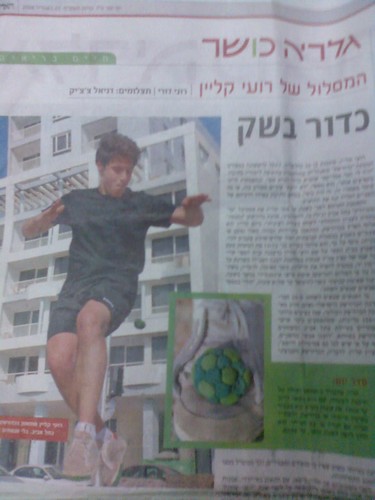

Translation:
A foot in the bag – Roy Klein's lane
Roy Klein, a 26 years old programmer from Herzliyya, first ran into the sport of footbag during his highschool years. "I had an American friends who brought a bag to school, and in recess we'd kick it around", He says. "I didn't know it was a sport, or anything about the world behind it, but it was fun". After highschool the two went their own separate ways and Klein abandoned the hobby.
The comeback happened about a year ago, when Klein attended the "Motomusic" festival in Tel Aviv, and found there, to his surprise, a footbag workshop. "I got into the sport and started practicing seriously". Klein is now the Israeli footbag champion, and practices very often (once or twice a week with a group, and 3-4 times a week solo). In addition, he teaches a group of 12-13 year olds once a week in the school "Roy Klein" in Raanana. (The school is named after an IDF officer who jumped on a hand grenade in order to save the lives of his soldiers). The duration of the practice, he says, depends on location and attendees. Intensive solo session takes about an hour, while a group session can last up to three hours, "depending on how many people show up".
Who are the people who come to play? About 25 members of the Israeli footbag association (a part of the International footbag association, in which more than 150 countries are represented), who meet every Friday afternoon at the Tel Aviv promenade and play footbag together. "We're mostly computer guys, but we have a psychologist and a doctor", mentions Klein. He says that the group footbag is especially fun since there are no winners and no losers, and the competitive element is removed.
Two weeks ago Klein returned from Japan, where he trained in Aikido, a martial art he intensively practiced until last year. "Before I started footbag I practiced 4 times a week, and then decided to split my attention, so now I practice Aikido twice a week". Before Japan he went to Barcelone, where he met local footbag players and received a warm welcome: "It's a very scattered community that constantly seeks out-of-country guests, to play with and compare tricks with".
According to Klein, footbag improves coordination: "And on a professional level it develops Aerobics and muscles. Not just in the legs, but throughout the body. Although control of the bag is done by the legs, the entire body works on keeping you balanced". From a personal perspective, Klein reports an added bonus in the form of a social network and a sense of achievement: "It's a sport that if you invest in it, you see results. Talent is not necessary, and you improve rapidly. In other words, it's a sport that encourages seriousness".
Right side green box- Diet:
"Before I started Aikido, I frequented the gym, and I was big and healthy", says Klein. "After I replaced the gym with Aikido, I began feeling weaker. I'm a long time vegetarian, and you could say I replaced meat with bread. This started to show, as I felt like I'm out of breath in classes. I decided to improve my diet and I try to keep it".
For breakfast, I eat musli (instead of bread and hummus); for lunch, half of the week a salad and the other half "flows with the people at work" and eat out; for dinner, "mom's food", mostly carbs like rice or pasta. In between he eats fruits: "Work provides appels, bananas, pears, and I eat 'em".
Left side green box – Footbag:
Footbag was invented in 1972 by a pair of Americans, with the goal of strengthening the knee of one of them, after an operation. Footbag is actually a name for three different disciplines: Net, which is similar to volleyball and played in pairs, where the main difference is the use of legs and is sort of a combination of tennis and volleyball; Freestyle, in which a player improvises before a panel of judges to the sound of music, and is judged by the tricks difficulty and how long he keeps it up ("similar to Rhythmic Gymnastics"); Circle, a game for a number of players who pass the bag around, with no winners or losers.
Klein reports that footbag, that entered Israel 10 years ago, is catching on and becoming very popular: "It's new, unique, is similar to soccer but more accessible and not as intimidating. Even those who can't play soccer like it and get hooked. Even though it's a very competitive sport in some disciplines, the circle is not, it's all about fun and there's no pressure to be the best; the emphasis is on team play and the added benefit of the togetherness".
Dark green middle box – Day agenda:
Klein wakes up at 9 am and hops on a train to work, where he usually stays until 19:30. Evening hours he spends either practicing Aikido or footbag, and the rest of the day he either goes out with friends or stays in with his girlfriend. He goes to sleep at around 2:30 am.